

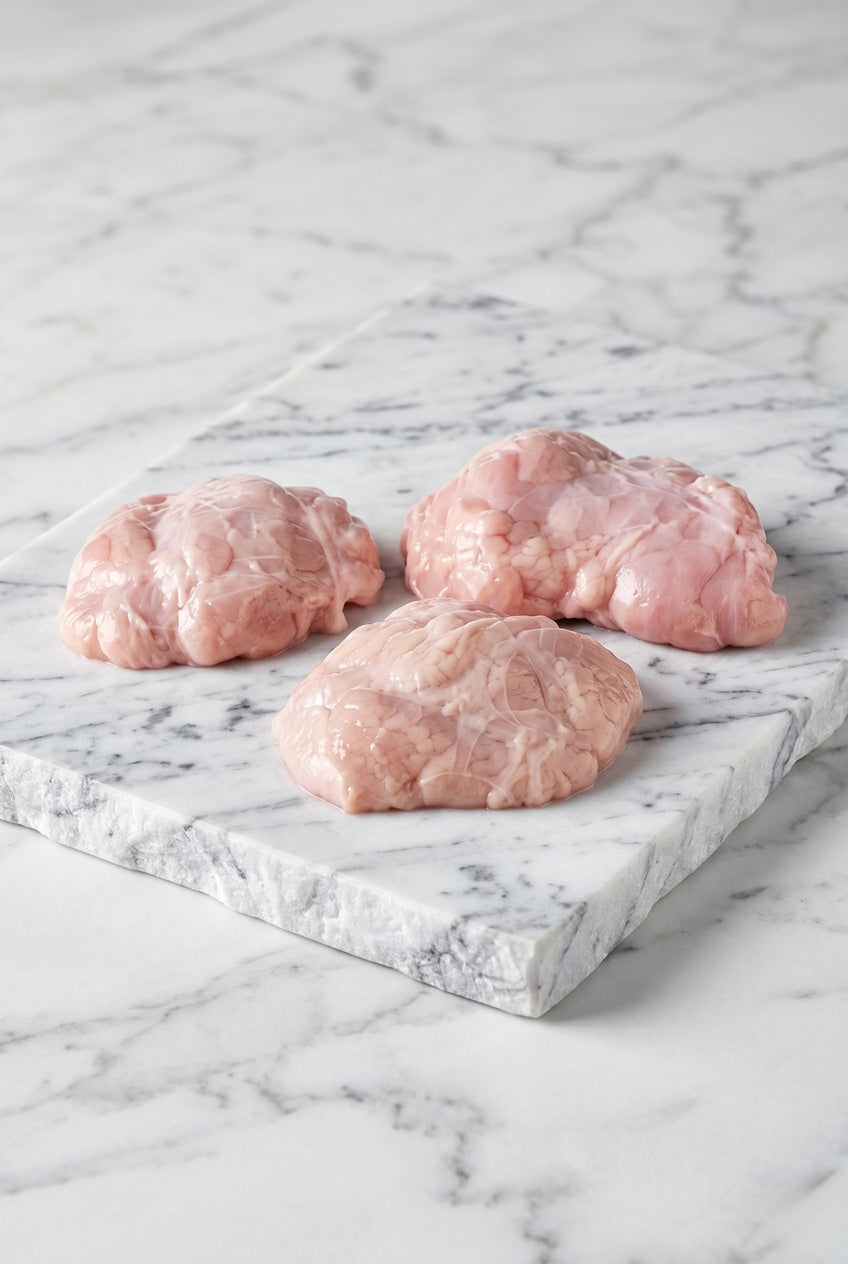
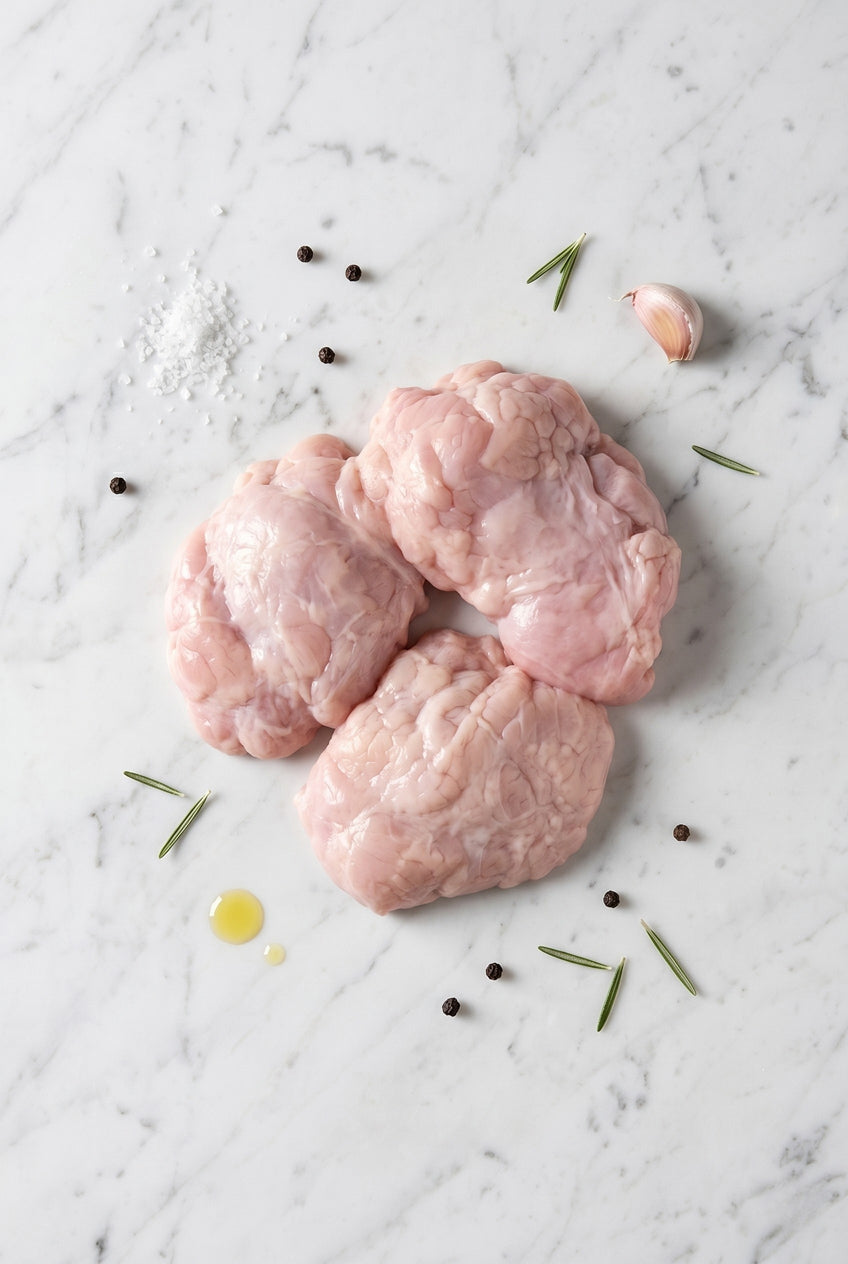
"A plump, delicate sweetbread, ready to be browned in butter for a crispy crust and an intensely creamy center."
Livraison Offerte
Dès 125€ d'achat
Chaîne du Froid
Fraîcheur garantie
Qualité Artisanale
Découpe tradition
Heart sweetbread is the centerpiece of noble offal, offering a generous, firm, and pearly white lobe. At Allaert Meat, we exclusively select these central cuts to guarantee meat free of superfluous membranes, ready to reveal its exceptional tenderness. After meticulous degorging and a quick blanching, this cut requires cooking in foaming butter to brown its surface while preserving its milky core. This creates a perfect contrast between a delicately caramelized crust and an incredibly tender interior with a subtle nutty flavor. Serve it simply drizzled with its cooking juices or accompanied by a creamy morel sauce to honor this exceptional product.
Does not contain: sulphur dioxide and sulphites, molluscs, celery, eggs, milk, crustaceans, lupin, peanuts, sesame, soy, gluten.
Delivery and freshness (Belgium only)
- Guaranteed cold chain: Your orders are carefully packed and shipped under controlled temperature (between 0 and 4°C) via DPD Fresh.
- Costs and delivery times: Calculated automatically when validating your cart.
- Receiving your package: As our products are ultra-fresh, your presence is essential at the time of delivery. Place the products in the refrigerator immediately upon receipt.
- Returns: As these are perishable goods, returns are not accepted. We cannot be held responsible in the event of your absence or an incorrect address during delivery.
- Customer service: A problem with your order (damaged or non-compliant package)? Contact us the same day with photos of the package and products at sales@allaert-meat.be or at +32 2 521 28 56.
Returns and refunds
- No standard returns: As these are perishable products subject to the cold chain, we do not accept returns or refunds for non-defective products to guarantee food safety.
- Exceptions (refund or replacement): We only intervene if the order is defective or non-compliant (damaged product, abnormal appearance or smell, missing or incorrect item, faulty packaging).
- Report a problem: Contact us as soon as possible after delivery with your order number, a description of the problem, and clear photos of the product and its packaging.
- Important instructions: For safety reasons, do not return any products to us without our prior validation. Keep the affected items chilled while we analyze the issue.
- Claims contact: Send your request to sales@allaert-meat.be or call +32 2 521 28 56.

Standard Allaert
Uncompromising quality since 1978
When you choose a cut of meat at Allaert, you're not just buying meat; you're participating in a legacy. Each cut is hand-selected by our master butchers, guaranteeing that only the very best reaches your table.
Delivery 0-4°C
Via DPD Fresh & Secure Chain
Artisanal know-how
Hand-cut and precision
Natural finesse
Natural finesse
Our selection emphasizes the delicacy of the meat and an even color, hallmarks of consistent quality. Exceptional provenance and careful rearing yield a fine grain and remarkable tenderness. The result is an elegant, light meat, perfect for precise cooking.

Everything you need to know before you buy
FAQ about Fresh sweetbreads (heart) | 1000 g
What is the difference between heart sweetbread and throat sweetbread?
Veal sweetbreads are divided into two parts. The "heart" (or "nut") is the round, fleshy, firm part, considered the noblest cut. The "throat" is more elongated and composed of multiple small lobes, ideal for stuffings or stews, but less presentable for whole pan-frying.
Should veal sweetbreads be blanched before cooking?
Absolutely. It is imperative to immerse the sweetbreads in a large quantity of cold water for at least two to three hours, changing the water regularly. This step helps to remove traces of blood and impurities, thus ensuring immaculately white meat.
How to properly blanch and peel this piece?
Submerge the blanched sweetbread in a pot of cold water, bring to a simmer for three minutes, then immediately refresh it in ice water. This process firms up the meat and allows you to easily remove the thin translucent membrane and the small vessels surrounding it, without damaging the lobe.
Why do some chefs press sweetbreads?
Pressing the sweetbreads (between two plates with a weight on top) in the refrigerator for a few hours compacts the fibers. This gives the sweetbreads a regular shape and denser texture, making it easier to slice into beautiful pieces and ensuring even cooking in the pan.
What's the best cooking technique for sweetbreads?
Sautéing is the supreme method. Lightly flour the pieces, then sear them in foaming butter (nut-brown butter), continually basting them. You will achieve a golden, crispy crust that contrasts beautifully with the tender, milky center of the meat.
What sides would best complement this tripe dish?
Its delicate flavor calls for elegant accompaniments. Wild mushrooms, especially morels or porcini, are its historical allies. A rich, buttery potato puree, crisp green asparagus, or a veal jus reduced with Vin Jaune will perfectly highlight its finesse.
- Choosing a selection results in a full page refresh.