

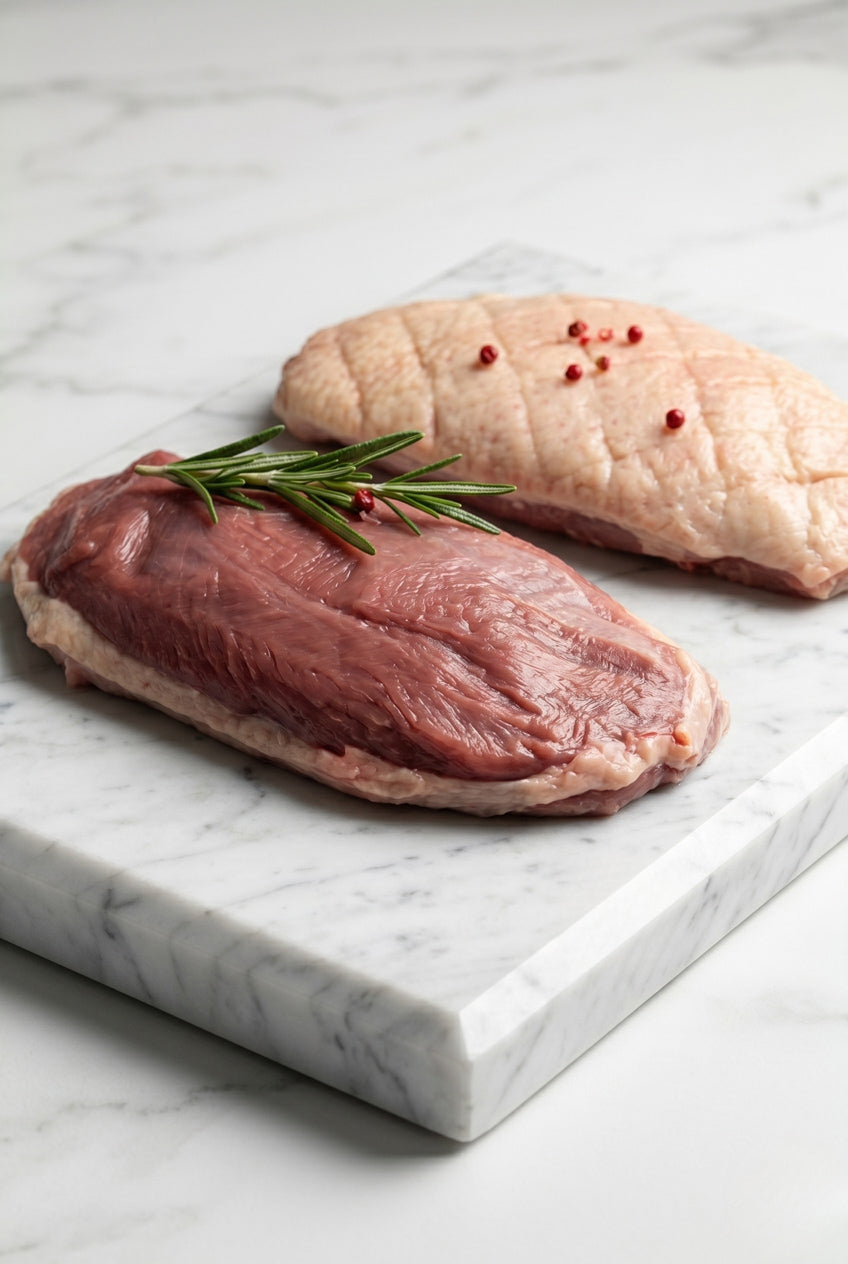
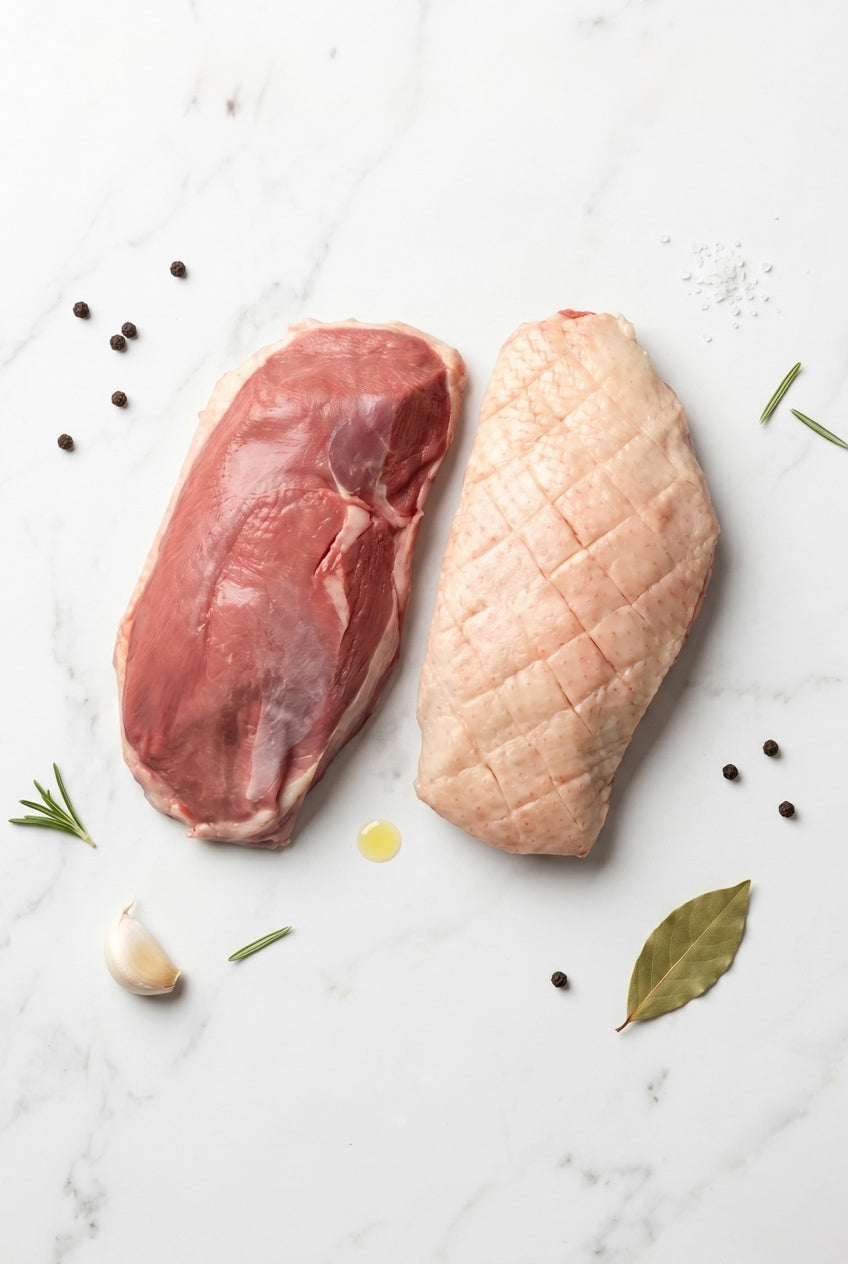
"A plump poultry with golden skin, raised outdoors to ensure tender, generous meat with an authentic taste."
Livraison Offerte
Dès 125€ d'achat
Chaîne du Froid
Fraîcheur garantie
Qualité Artisanale
Découpe tradition
This duck breast is distinguished by its deep red flesh and generous fatty covering, guaranteeing exceptional juiciness.
At Allaert Meat, we select fleshy pieces from foie gras ducks, ensuring a tender chew and a pronounced regional flavour.
To prepare it, score the skin with a knife without cutting into the meat, then start cooking cold, fat-side down, to gently render the fat.
Once the skin is crispy, sear the flesh side briefly to achieve a perfect rare to medium-rare doneness.
Let the meat rest for a few minutes under aluminium foil before slicing, so that the juices are evenly distributed.
Does not contain: sulphur dioxide and sulphites, molluscs, celery, eggs, milk, crustaceans, lupin, peanuts, sesame, soy, gluten.
Delivery and freshness (Belgium only)
- Guaranteed cold chain: Your orders are carefully packed and shipped under controlled temperature (between 0 and 4°C) via DPD Fresh.
- Costs and delivery times: Calculated automatically when validating your cart.
- Receiving your package: As our products are ultra-fresh, your presence is essential at the time of delivery. Place the products in the refrigerator immediately upon receipt.
- Returns: As these are perishable goods, returns are not accepted. We cannot be held responsible in the event of your absence or an incorrect address during delivery.
- Customer service: A problem with your order (damaged or non-compliant package)? Contact us the same day with photos of the package and products at sales@allaert-meat.be or at +32 2 521 28 56.
Returns and refunds
- No standard returns: As these are perishable products subject to the cold chain, we do not accept returns or refunds for non-defective products to guarantee food safety.
- Exceptions (refund or replacement): We only intervene if the order is defective or non-compliant (damaged product, abnormal appearance or smell, missing or incorrect item, faulty packaging).
- Report a problem: Contact us as soon as possible after delivery with your order number, a description of the problem, and clear photos of the product and its packaging.
- Important instructions: For safety reasons, do not return any products to us without our prior validation. Keep the affected items chilled while we analyze the issue.
- Claims contact: Send your request to sales@allaert-meat.be or call +32 2 521 28 56.

Standard Allaert
Uncompromising quality since 1978
When you choose a cut of meat at Allaert, you're not just buying meat; you're participating in a legacy. Each cut is hand-selected by our master butchers, guaranteeing that only the very best reaches your table.
Delivery 0-4°C
Via DPD Fresh & Secure Chain
Artisanal know-how
Hand-cut and precision
Honest meat
Poultry selected for a firm texture and authentic flavor
We select poultry from farms where quality takes precedence over speed. This yields firmer, more flavorful meat, and skin that browns better when cooked. Every choice aims for simple, pure, and delicious poultry, from everyday meals to exceptional dining.

Everything you need to know before you buy
FAQ about Duck breast | ≈ 400 g
How do you properly score duck breast skin before cooking?
Score the fat layer with a sharp knife, spacing the cuts about one centimeter apart. The secret is to cut only the fat, never piercing the red flesh underneath, which would cause a loss of juices and dry out the meat during cooking.
Why should you start cooking duck breast in a cold pan?
Placing the duck breast skin-side down in a cold pan allows the fat to render slowly and drain as the temperature rises. If you sear it over high heat, the skin will burn before the fat has had time to render, depriving you of that characteristic crispness.
What is the ideal cooking for a duck breast?
As a butcher, I highly recommend cooking it medium-rare, or even rare in the center. An internal temperature of around 55°C is optimal. Beyond that, the duck meat loses its tenderness, becomes stringy, and develops too strong a liver-like flavor that masks the meat's delicacy.
What to do with the rendered fat collected in the pan?
Whatever you do, don't throw it away. This duck fat is liquid gold in the kitchen. Filter it and store it in the refrigerator to sauté Sarladaise potatoes, mushrooms, or even to confit vegetables. It adds an exceptionally rustic flavor.
Should the duck breast be rested after cooking?
This is a crucial step. Let the duck breast rest for 5 to 7 minutes on a board, loosely covered with aluminum foil. This allows the muscle fibers, contracted by the heat, to relax and the juices to redistribute evenly throughout the piece.
What should I serve with this rich cut of meat?
Duck breast pairs very well with sweet and savory combinations. A balsamic vinegar, honey, or red fruit (cherries, figs) reduction perfectly cuts through the richness of the duck fat. For sides, potatoes sautéed in duck fat or a pan-fry of fresh porcini mushrooms enhance its earthy character.
- Choosing a selection results in a full page refresh.